The Brain Under Pressure
How Sleep, Stress, Exercise, Nutrition, and Modern Life Shape Mental Health and Cognitive Performance

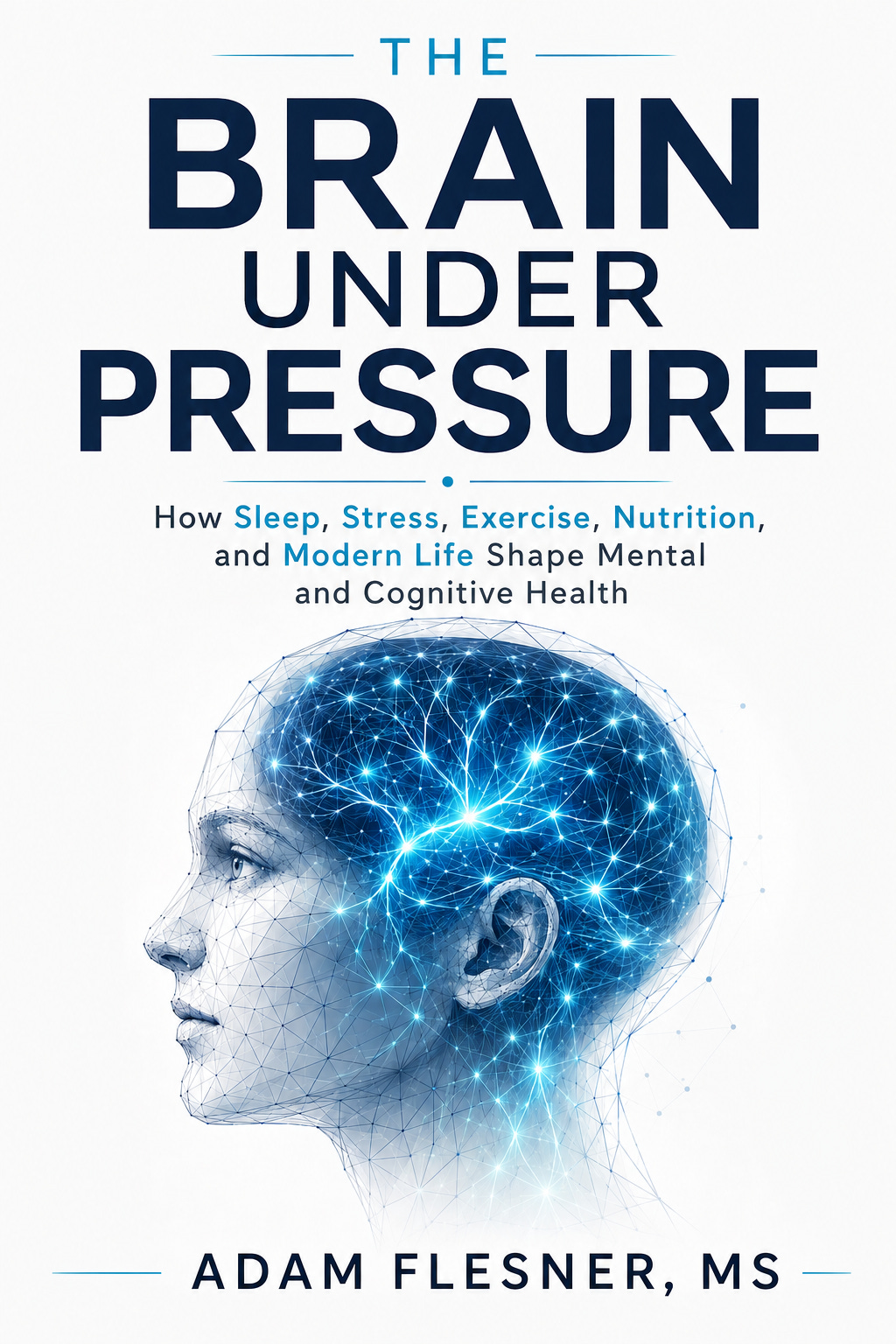
Most of you know about Still Here: A Bipolar Survival Manual. That book was personal — a first-person account of what it looks like to survive serious psychiatric illness and come out the other side with something useful to say about it.
This one is different.
Before I get into what The Brain Under Pressure: How Sleep, Stress, Exercise, Nutrition, and Modern Life Shape Mental and Cognitive Health covers, some context about where it comes from. My academic background is in exercise and nutrition science — a bachelor’s degree from Missouri State University in exercise and movement science with minors in nutrition and biomedical sciences, followed by a master’s degree in exercise and nutrition science from the University of Tampa. I held certifications from the National Strength and Conditioning Association and the American College of Sports Medicine. After that I have spent years in clinical healthcare settings — orthopedics, pain management, respiratory, sleep medicine, and wound care — working alongside patients managing chronic conditions and navigating real-world medication effects. I am also a contributing writer for the International Bipolar Foundation. The lived experience with serious psychiatric illness that Still Here was built on is still there. But this book draws more heavily on the decade of scientific training and clinical work that sits alongside it.
The Brain Under Pressure is not a memoir. It is not a survival story. It is not written specifically for people with bipolar disorder, and it does not require any personal experience with psychiatric illness to be useful. It is written for anyone who wants to understand what is actually happening in their brain — and why so many people feel mentally exhausted, emotionally reactive, cognitively foggy, and generally like they are running on empty despite their best efforts.
The argument the book makes is straightforward: the brain is a biological system, and most conversations about mental health still are not accounting for that. The conversation tends to split between the psychological — therapy, mindset, emotional regulation skills — and the pharmaceutical — medication, diagnosis, clinical intervention. Both of those matter. But there is a biological middle ground between them that gets almost no attention: the lifestyle conditions that determine how well your brain can actually function before any psychological or pharmaceutical intervention begins. Sleep architecture. Stress physiology. Blood sugar and prefrontal function. Neuroinflammation. Exercise-driven neuroplasticity. Mitochondrial health. Neurotransmitter substrate availability.
That middle ground is what this book covers.
You do not need a diagnosis to benefit from understanding it. You need a brain — and a reasonable suspicion that the conditions you are asking it to operate in might be part of why it keeps running into the same walls.
Here is what is actually in it.
If you feel mentally exhausted despite doing everything right
Chapter 1 explains why the combination of modern sleep patterns, chronic stress, ultra-processed food, and sedentary behavior creates a biological environment the brain was not designed to function in. The exhaustion has a mechanism. Understanding it changes how you address it.
If you have been told depression is a serotonin deficiency
Chapter 8 covers what the neuroscience actually shows. The inflammatory model, HPA axis dysregulation, mitochondrial energy failure, default mode network hyperactivity, and why understanding the real biology changes what you do about it.
If you struggle with sleep and cannot understand why it affects everything else
Chapter 3 covers the glymphatic system and its role in clearing amyloid-beta overnight, slow-wave sleep and cellular restoration, REM sleep and emotional memory processing, and circadian biology. It explains why cutting the last two hours of sleep costs disproportionately more than the math suggests.
If you want to understand why exercise actually works on the brain
Chapter 4 covers BDNF and hippocampal neurogenesis, mitochondrial biogenesis driven by zone 2 training, lactate as a direct BDNF stimulus, irisin and myokine signaling, and the endocannabinoid system — which, not endorphins, explains the runner’s high. The SMILE trial at Duke found aerobic exercise produced equivalent remission rates to antidepressant medication at 16 weeks, with lower relapse rates at 10 months. Chapter 4 explains the mechanisms behind that finding.
If you want to understand what food actually does to your brain
Chapters 5 and 6 cover blood sugar and prefrontal function, reactive hypoglycemia and emotional reactivity, the inflammatory model of depression and what diet has to do with it, gut-brain axis signaling, and the specific dietary patterns that drive neuroinflammation versus the ones that reduce it.
If you manage a mood disorder and want to understand your own neurology
Chapter 9 covers bipolar disorder, ADHD, burnout, and trauma through a biological lens. The circadian vulnerability of bipolar disorder. The dopamine sensitization model. The kindling hypothesis and what it means structurally. What stress sensitization looks like in the brain over time.
If you want honest supplement guidance
Chapters 10 and 11 cover the evidence hierarchy without marketing language. What has genuine randomized controlled trial evidence. What does not. What carries specific activation risk for people managing mood disorders and why. NAC, magnesium, omega-3s, vitamin D, zinc, B vitamins, adaptogens, and nootropics — all covered with the skepticism the category deserves and the specificity it rarely gets.
If you want to know what to actually do with all of this
Chapter 13 builds a sequenced protocol framework. Sleep first. Stress recovery second. Movement third. Nutrition fourth. Supplementation last. The sequencing matters because each domain sets the biological conditions for the next to work.
The appendices are worth reading on their own.
Most books bury the appendices as afterthoughts. These are not supplementary material — they are where a significant portion of the book’s practical value lives.
Appendix A: Foundational Lab Work and Biomarker Guide
This is not a list of tests your doctor already orders. It covers the markers most relevant to brain health that standard panels routinely omit, with two ranges for each: the standard laboratory reference range that identifies disease, and the functional optimal range associated with actual neurological performance.
Fasting insulin and HOMA-IR for early insulin resistance that precedes glucose dysregulation by years. High-sensitivity CRP and homocysteine as the inflammatory and neurotoxicity markers most predictive of depression severity and dementia risk. Active B12 versus serum B12 and why the standard range permits functional insufficiency. 25-hydroxyvitamin D with a target of 50–80 ng/mL rather than the permissive 20 ng/mL threshold. A full thyroid panel — TSH, free T4, free T3, and TPO antibodies — and why TSH alone misses subclinical hypothyroidism and autoimmune thyroid disease that drive treatment-resistant depression in a meaningful proportion of people. Reverse T3 and why it rises under chronic stress to impair thyroid function when conventional markers look normal.
The appendix closes with a complete testing strategy organized into a foundational panel you can bring to any standard preventive care visit.
Appendix B: Exercise Programming for Brain Health
This is the most detailed appendix in the book and probably the most unusual thing in the brain health genre. It includes complete population-specific programming for beginners, intermediate trainees, advanced athletes, adults 60 and older, and a dedicated clinical section for people managing depression, anxiety, and bipolar disorder — including what to do during active episodes, partial recovery, and maintenance, and what intensities carry specific mood activation risk in sensitized nervous systems.
It also includes a complete framework for using AI language models as personalized programming assistants, with six detailed prompt templates ready to copy into ChatGPT or Claude — covering beginner program generation, progressive overload planning, mood-sensitive programming, older adult programming, advanced block periodization, and real-time session adjustment for when your HRV is down or you only have 20 minutes. This section exists because access to quality exercise programming should not depend on the ability to afford a personal trainer.
Appendix C: Nutrition Implementation Guide
Translates the mechanisms from the nutrition chapters into practical frameworks organized by population and context. Meal timing and protein distribution for blood sugar stability and muscle protein synthesis. Mediterranean dietary pattern implementation. Anti-inflammatory food selection. Gut microbiome support through fiber and fermented foods. Population-specific guidance for older adults with anabolic resistance, people managing mood disorders, and people rebuilding after a period of poor nutrition.
Appendix D: Supplement Reference Guide
A systematic reference organized by evidence tier. Tier 1 covers compounds with multiple randomized controlled trials and direct brain health or mood outcomes. Tier 2 covers compounds with mechanistic evidence and preliminary human data. Tier 3 covers compounds that are popular but lack clinical trial support. Each entry includes mechanism of action, relevant evidence, standard dosing ranges, and specific cautions for people on psychiatric medications.
Appendix E: Sleep and Recovery Checklist
A practical implementation checklist organized by time of day: morning light protocols, caffeine cutoff timing based on half-life, evening light management, pre-sleep environment optimization, and the specific CBT-I techniques with the strongest evidence for chronic insomnia. Covers alcohol’s effect on REM architecture, why melatonin doses above 1mg are not supported by the evidence, and how to use heart rate variability as a daily readiness signal.
Appendix F: Mental Health, Medication, and Supplement Considerations
The appendix most people managing a psychiatric condition will find most directly useful. Covers what patients are rarely told about psychiatric medications and metabolism — antipsychotic-induced metabolic syndrome, the direct insulin signaling effects of certain medications independent of weight gain, and what the evidence supports for addressing it. Serotonin syndrome risk and the specific supplement combinations that elevate it. Drug-supplement interactions including St. John’s Wort and cytochrome P450 interactions with common psychiatric medications. NAC evidence in bipolar depression. Lithium and thyroid function. Omega-3 and anticoagulation.
This appendix is written for the person who is already on medication and wants to know what they can safely add, what they should avoid, and what their prescriber may not have told them.
302 pages. Written for anyone who wants to understand the biology their mental health runs on.
Available on Amazon in Kindle, paperback, and hardcover: The Brain Under Pressure: How Sleep, Stress, Exercise, Nutrition, and Modern Life Shape Mental and Cognitive Health
Superb article to introduce your new book. I have to say I’m in the “do I really want to know more, or, now that I’m stable for the first time, will this just send me off on a track I can’t implement due it complexity”!
I think it’s one for next year.
I cannot afford it. Can you please let me access its pdf